
Choosing the best ai writing tools for SEO is an evaluation problem, not a taste test. The winner is the platform that reliably ships publishable pages that get indexed fast, match your brand voice, earn rankings on real SERPs, and reduce editorial workload without creating factual or compliance risk. This guide gives you a repeatable, score-based method to test tools on the same keyword set and prove ROI with traffic.
Key Takeaways
- Build your evaluation around SEO outcomes: indexing speed, ranking movement, internal linking quality, and topical coverage, not “sounds good” writing.
- Run a controlled SERP test with the same keyword set, same site section, and the same publishing window so differences show up in Search Console, not in opinions.
- Score brand voice, factuality, and editorial workload with a rubric that turns subjective feedback into numbers your stakeholders will accept.
Table of Contents
- What evaluation criteria predict SEO performance (not just writing quality)?
- The SEO-critical capabilities to evaluate
- How do you test tools on the same keyword set and SERP?
- Build a keyword set that exposes strengths and weaknesses
- Publish in a way that does not sabotage indexing
- Measure ranking movement the right way
- How do you score brand voice, factuality, and editorial workload?
- A scoring rubric that marketing and legal both accept
- Don’t outsource QA to an “AI content detector tool”
- How do you roll out an AI writing platform into a weekly publishing cadence?
- Start with a cadence that your crawl budget and team can sustain
- Build the minimum viable workflow (and automate the rest)
- Multilingual expansion: treat it like SEO, not translation
- Analytics feedback loops tied to indexing and rankings
- A practical decision framework for “best ai writing tools” in 2026
What evaluation criteria predict SEO performance (not just writing quality)?
The criteria that predict SEO performance are the ones that influence crawling, indexing, relevance, and trust signals. A tool can produce fluent copy and still fail because it does not understand search intent, entity coverage, or how your site architecture distributes internal PageRank.
Start by separating “writing quality” from “ranking readiness.” For SEO, the tool has to consistently deliver pages that a crawler can interpret and a human can trust.
The SEO-critical capabilities to evaluate
A strong AI powered writing assistant for SEO should show competence in five areas that map directly to how Google evaluates pages:
1) SERP intent matching and format discipline
If a query returns listicles and comparison tables, a narrative essay will underperform even if it reads beautifully. Your tool should produce the right page type on the first draft: definitions for “what is,” step-by-steps for “how to,” and commercial comparison structures for “best” queries.
2) Entity coverage and topical depth
Google’s systems rely heavily on entities and relationships, not keyword repetition. Your drafts should naturally include the concepts that belong in the topic cluster (tools, workflows, schema, internal links, editorial QA, crawlability). If you want a sanity check on what “entity optimization” looks like in practice, use the framing in Writing AI for SEO: how to get rankings, not fluff and compare it to what your candidate tools generate.
3) Internal linking suggestions that respect your architecture
Generic “link to your services page” suggestions are noise. Good tools propose links based on your existing URL structure, anchor text variety, and where authority should flow. This is one of the fastest ways to tell whether a writing AI understands SEO beyond paragraphs.
4) Technical SEO output: metadata, schema, and on-page hygiene
At minimum, you should be able to control title tags, meta descriptions, headings, image alt text, canonical behavior, and basic schema types (Article, FAQ when appropriate, BreadcrumbList). Google documents structured data requirements and supported formats in its Search Central structured data documentation. If your tool cannot produce clean schema or forces you into manual cleanup, your editorial costs will spike.
5) Publishing and feedback loop integration
SEO is a system. If the tool cannot publish to your CMS, schedule drafts, and feed performance data back into the plan, you will stall after the pilot. This is where seo automation matters: the content machine has to run weekly, not as a one-off experiment.
A practical note: “AI content detectors” are not an evaluation criterion for SEO performance. Google’s guidance focuses on content quality and helpfulness, not whether a detector guesses it was AI-written. Google states this explicitly in its guidance on AI-generated content. Evaluate outcomes, not vibes.
How do you test tools on the same keyword set and SERP?
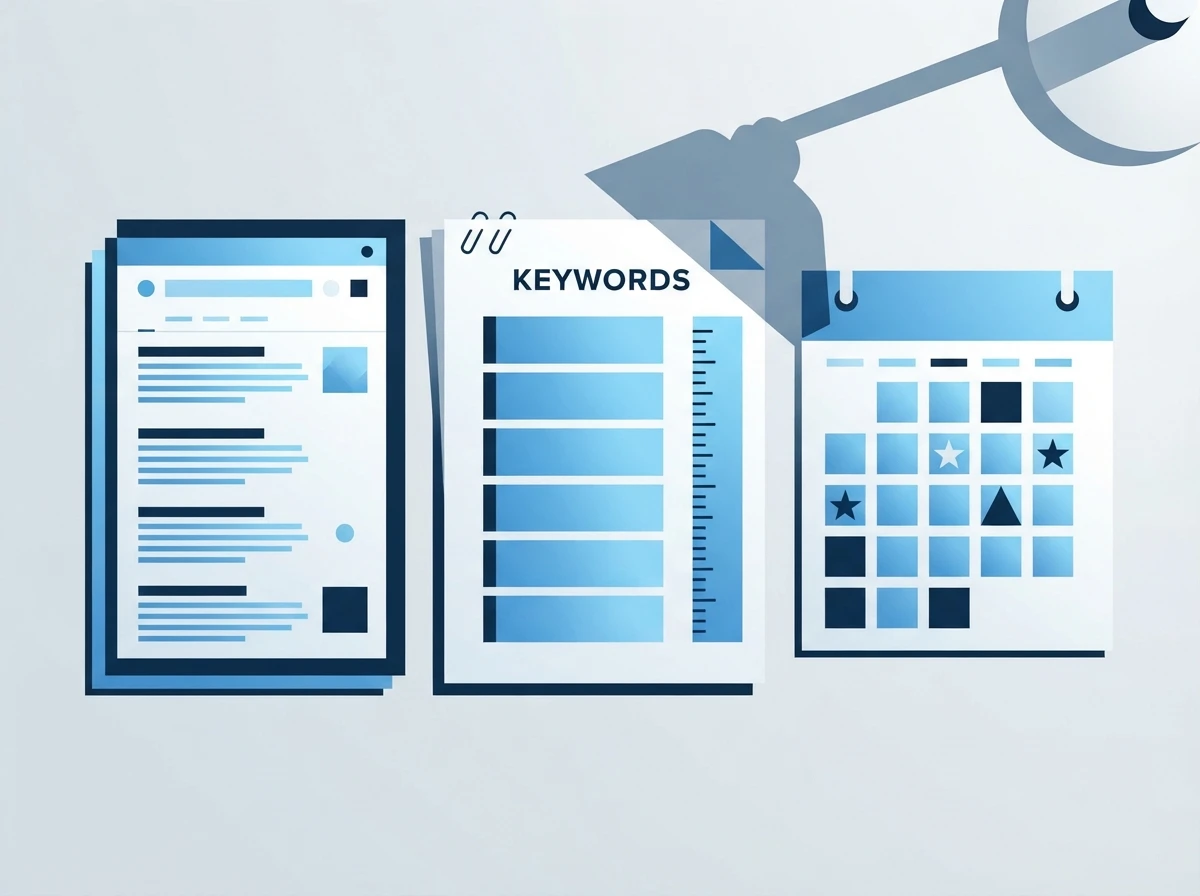
A fair test controls variables. Most internal tool bake-offs fail because teams compare different topics, different writers, different publish dates, and different site sections. Then they argue about results that were never comparable.
Here is a controlled test design that works for in-house teams and produces evidence you can defend.
Build a keyword set that exposes strengths and weaknesses
Pick 12 to 20 keywords from one tight cluster on your site, all targeting the same audience segment. Mix intent types so the tool has to handle different SERP formats (informational, commercial, troubleshooting). Use the same keyword difficulty source across the set (Ahrefs, Semrush, or your internal model), and lock the list before you generate any drafts.
Keep the playing field level:
- Choose one site section (for example, /blog/ or /resources/) with similar internal linking and template structure.
- Publish within the same 7 to 10 day window to reduce seasonality and crawl timing differences.
- Use the same on-page template: same CTA placement, same author box policy, same image policy.
Publish in a way that does not sabotage indexing
Indexing is where many AI publishing pilots quietly die. Bulk publishing can trigger crawl budget constraints, sitemap delays, or CMS quirks that slow discovery. If you are on Wix, it is worth reviewing how to fix indexing after auto-publishing on Wix before you run the test, because the fastest “tool win” is often just “the pages got indexed.”
Track indexing explicitly:
- Submission: confirm the URL is in the XML sitemap and internally linked from at least one crawlable hub page.
- Discovery: watch “Discovered, currently not indexed” and “Crawled, currently not indexed” in Search Console.
- Time-to-index: measure days from publish to first “Indexed” status.
Google explains how crawling and indexing work in its Search Central crawling documentation. Use those status labels in your reporting so stakeholders see this as an engineering problem, not a content argument.
Measure ranking movement the right way
For a short pilot, you are not trying to “win the SERP.” You are trying to compare tools. Focus on leading indicators:
- Impressions growth for the tested URLs (Search Console Performance report).
- Average position trend for the exact query set.
- Click-through rate changes when titles and snippets differ meaningfully.
If your org insists on a rank tracker, use it as a secondary view. Search Console is the source of truth for what Google actually served.
How do you score brand voice, factuality, and editorial workload?

If you cannot score it, you cannot defend it. This is where most “best ai for writing” evaluations collapse into subjective debate, especially when executives read one draft and decide based on personal preference.
Use a rubric that converts editorial pain into numbers.
A scoring rubric that marketing and legal both accept
Create a simple scorecard per article, then average by tool. You want consistency, not one heroic draft.
Two implementation details matter.
First, define “brand voice” concretely. Teams argue because “on brand” is vague. If your current content sounds robotic after adopting a writing AI, you need a voice spec and a training loop. The practical fix is outlined in brand voice matching to fix robotic AI blog posts, and it doubles as a checklist for what to grade.
Second, factuality must be enforced with an editorial policy, not hope. If your tool can function as an ai powered paraphrasing tool, test it on a source passage and see whether it preserves meaning or introduces new claims. Paraphrasing errors are sneaky: they read fluent, then legal flags them, then publishing stops.
Don’t outsource QA to an “AI content detector tool”
An ai content detector tool cannot validate truth. It can only guess authorship patterns, and those tools are notoriously inconsistent across models and prompts. Your QA workflow should validate:
- Claims that require a source (pricing, legal, medical, technical specs)
- Product functionality statements
- Dates, statistics, and named entities
If you need automation, automate the checklist and the citation requirement, then keep a human reviewer for high-risk categories.
How do you roll out an AI writing platform into a weekly publishing cadence?
A rollout succeeds when it becomes boring: briefs go in, drafts come out, QA happens on schedule, and performance data updates the plan. That requires a workflow that reduces friction for everyone who touches content.
Start with a cadence that your crawl budget and team can sustain
Weekly publishing cadence is a throughput problem. If your CMS, internal linking, and QA cannot keep up, you will publish a burst and then stop, which kills topical authority momentum.
Set a cadence you can defend for 90 days. For many in-house teams, that is 2 to 5 posts per week for one cluster, then expand. If you are debating cadence tradeoffs, cadence vs quality for SEO posting schedules lays out the practical constraints: editorial bandwidth, indexing, and internal link maintenance.
Build the minimum viable workflow (and automate the rest)
A workable weekly system usually looks like this:
- Research: keyword clustering, SERP notes, internal link targets, and a brief template
- Drafting: the writing AI generates the first version with headings, title/meta, and link suggestions
- QA: brand voice check, fact check, compliance check, and on-page review
- Publish: scheduled release, sitemap inclusion, and internal link placement from hubs
- Feedback loop: Search Console indexing and query data drives the next briefs
Where VellumUp fits in this landscape is end-to-end automation: it studies your site, builds a strategy, writes in your voice, and auto-publishes on a schedule, with optional translation across 50+ languages. If you are evaluating platforms rather than point tools, CMS integration is a hard requirement. Review the available connectors in VellumUp’s CMS and webhook integrations and make “publishability” a scored criterion, not a nice-to-have.
Multilingual expansion: treat it like SEO, not translation
Auto-translate features can scale traffic, but only if the workflow respects local search intent, hreflang, and internal linking per language folder. A writing ai that simply translates an English article word-for-word often misses the local SERP format and query vocabulary. Your rollout plan should include a pilot language, a localized keyword set, and a QA reviewer who actually reads the language.
Analytics feedback loops tied to indexing and rankings
If you want ROI proof, build a content tracker view that combines:
- Publish date and tool used
- Indexing status and time-to-index
- Query impressions and clicks (Search Console)
- Ranking trend for the target query set
- Conversions attributed to the URL (GA4 or your analytics)
Make sure your analytics is configured correctly before the pilot. If your team needs a clean setup, use how to set up Google Analytics as a practical starting point for getting the plumbing right on sites where publishing is automated and frequent.
A practical decision framework for “best ai writing tools” in 2026
The best ai writing tools for SEO are the ones that reduce time-to-publish while improving indexability, relevance, and consistency across a topic cluster. If a tool cannot publish reliably, cannot support internal linking, or cannot maintain voice and factuality at scale, it will fail the moment you try to run weekly.
If you want to skip the piecemeal stack and evaluate an end-to-end system that handles research, writing, brand voice matching, and auto-publishing with multilingual expansion, take a look at VellumUp and see our plans to match the workflow to your target cadence.